Star Trek opening titles
1966– · 12 series · 20 sequences
Six decades of the same brief — a ship, a starfield, a fanfare — reinterpreted by every era of television technology that came along, from a physical model on wires to a title card that assembles itself.
In order of first broadcast
 2 sequences
Star Trek
The one that set the shape of every space-opera opening since: a ship crossing the frame, a captain narrating a mission statement, and a melody built to be hummed. Alexander Courage wrote it as a fanfare and a lounge tune at the same time.
- Season 1
- Seasons 2–3
 1 sequence
Star Trek: The Animated Series
Filmation's Saturday-morning continuation, with most of the original cast back on microphone duty. The theme is Courage's melody rescored for a cartoon orchestra, brighter and quicker than the live-action original.
- Seasons 1–2
 3 sequences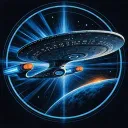
Star Trek: The Next Generation
The Enterprise-D passing the camera at warp while Patrick Stewart reads the mission statement. Stately, slow and completely confident — it takes almost a minute and a half before anything happens, and it never once feels the need to hurry.
- Season 1
- Season 2
- Seasons 3–7
 2 sequences
Star Trek: Deep Space Nine
A title sequence that starts still and learns to move. The station hangs motionless in the early years; by the war it is surrounded by traffic, which is the whole arc of the show in ninety seconds.
- Seasons 1–3
- Seasons 4–7
 2 sequences
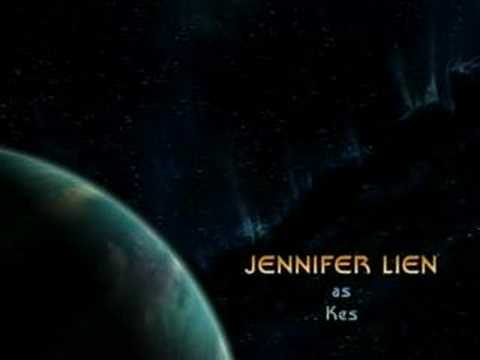
Star Trek: Voyager
The most purely beautiful of the Trek openings — Voyager skimming a comet, threading a nebula and sliding past a gas giant while Jerry Goldsmith writes the loneliest theme in the franchise. Nothing about it is in a hurry to get home.
- Seasons 1–3
- Seasons 4–7
 2 sequences
Star Trek: Enterprise
The franchise's most argued-over opening: no orchestra, no starfield, but a montage of real human exploration — sailing ships, biplanes, spacesuits — under a soft-rock ballad. Half the audience never forgave it, which is its own kind of achievement.
- Seasons 1–2
- Seasons 3–4
 2 sequences
Star Trek: Discovery
A complete break from every Trek opening before it — no ship, no narration, just schematic drafting-table renderings of Starfleet hardware assembling and dissolving in empty space, with a pair of hands reaching through it all.
- Seasons 1–2
- Seasons 3–5
 1 sequence
Star Trek: Lower Decks
The joke is in the structure: it opens exactly like a heroic Trek title sequence, and then the ship spends the entire minute getting wrecked by everything it meets. The Cerritos never wins a single shot of its own opening.
- Seasons 1–5
 2 sequences
Star Trek: Picard
An opening about memory rather than exploration. Fragments of a life — a vineyard, a Borg cube, a face — resolve out of swirling particles, and only at the very end does it admit it is a Star Trek show.
- Seasons 1–2
- Season 3
 1 sequence
Star Trek: Prodigy
Made for viewers who had never seen a Star Trek before, and it shows in the best way — the Protostar streaks through bright, candy-coloured space on a theme with more wonder in it than most of the grown-up entries.
- Seasons 1–2
 1 sequence
Star Trek: Strange New Worlds
A deliberate return to the old shape after two shows that avoided it — the Enterprise sweeping past ringed planets and ice moons, Pike narrating, and a theme that keeps reaching for Courage's original without ever quite quoting it.
- Seasons 1–3

Star Trek: Section 31
The franchise's black-operations division, given a feature-length outing of its own.
- Season 1